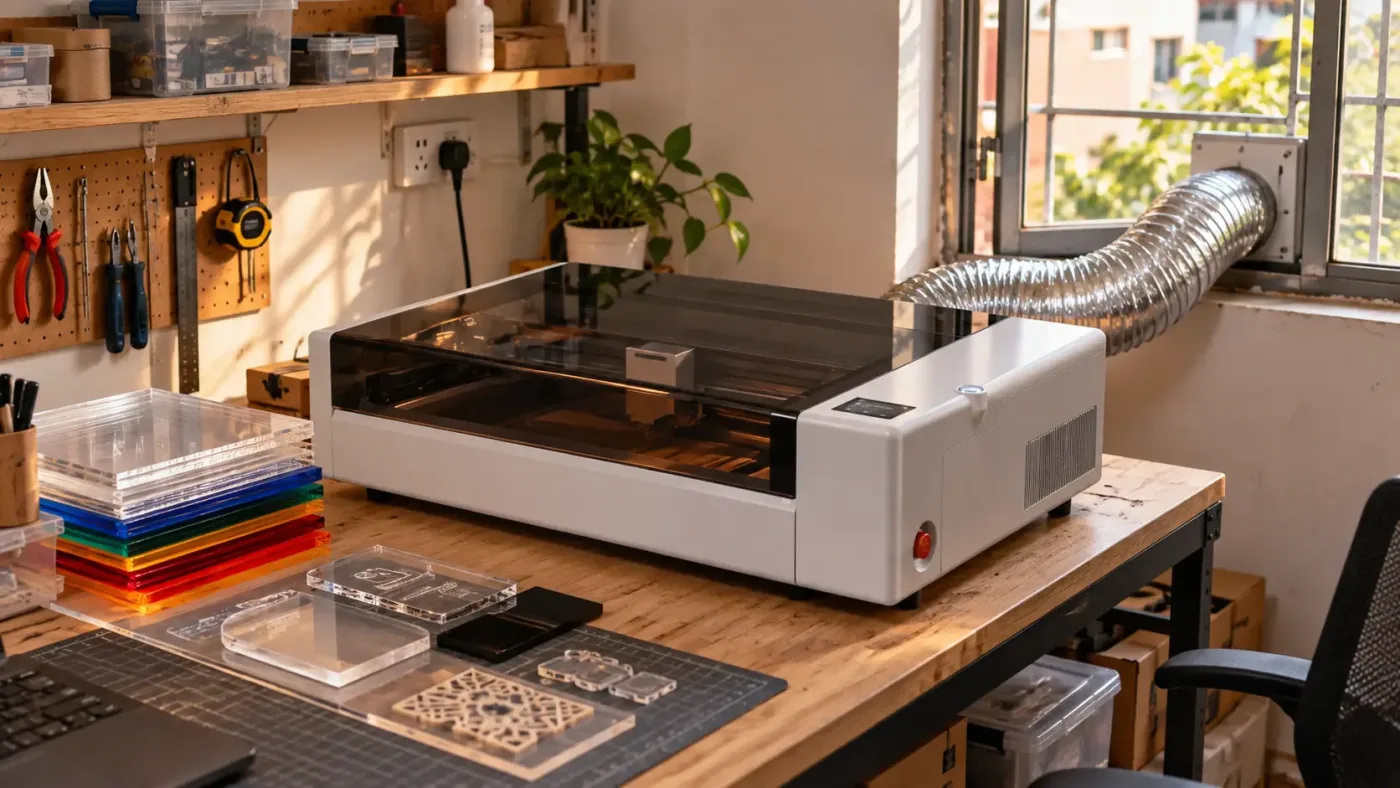
Bambu Lab announced the R1 on 22 September 2026. It is a 55 W CO₂ laser cutter and engraver, and the first product in the company's history that is not a 3D printer. The R1 marks the start of a separate laser product line for the Shenzhen-based company, which is best known for its X1, P1, A1 and H2 series 3D printers.
This article summarises what Bambu Lab has officially confirmed about the R1: specifications, price, accessories, safety classification and availability, plus what the machine means for makers and small businesses in Pakistan. Every specification below is taken from Bambu Lab's own launch announcement; see the sources at the end.
Bambu Lab R1 at a glance
| SpecificationBambu Lab R1 | |
| Machine type | Enclosed desktop CO₂ laser cutter and engraver |
| Laser power | 55 W CO₂ |
| Working area | 600 × 300 mm |
| Maximum material length | Up to 3,000 mm with the Conveyor accessory (sold separately) |
| Maximum speed | Up to 1,000 mm/s |
| Cutting capacity (stated) | Up to 18 mm black walnut plywood; up to 20 mm acrylic |
| Cuts and engraves | Wood, acrylic (including clear acrylic), leather, paper, fabric |
| Engraves only | Glass, stone, coated metals |
| Positioning accuracy | Under 0.2 mm when aligning to printed graphics (TriSense); 0.1 mm over 600 mm travel with the optional Vision Encoder |
| Laser safety class | Class 1 (IEC 60825-1) when fully enclosed; Class 4 with Riser Base or Conveyor fitted |
| Software | Bambu Suite (Windows and macOS), MakerWorld |
| Launch price | US$2,499 (US, before tax, shipping included); €2,499 (EU, tax included, shipping excluded) |
| Announced | 22 September 2026 (pre-orders opened the same day) |
| Shipping | Bambu Lab stated shipping would begin in October 2026 |
What is the Bambu Lab R1?
The R1 is a standalone CO₂ laser for cutting and engraving. Bambu Lab had already added laser modules to its H2D and H2S "Laser Edition" 3D printers; the R1 takes laser processing out of the printer and into a dedicated machine.
The choice of a CO₂ laser matters. Most hobby laser engravers use a diode laser, whose beam passes straight through transparent materials. A CO₂ laser beam is absorbed by clear acrylic and glass, so the R1 can cut clear acrylic and engrave glass, which diode machines generally cannot. Bambu Lab also says the CO₂ laser cuts thicker wood than a diode laser, faster and with less charring on the edges.
Key features
1. Automatic laser alignment
In any CO₂ laser, the beam travels from the tube to the lens by bouncing off a series of mirrors. If one mirror drifts out of position, cutting power drops sharply. On most machines, re-aligning the mirrors is a manual job with thermal paper, test pulses and adjustment screws, which can take a beginner an hour or more.
The R1 automates this. A Laser Alignment Sensor (a small plate with a target cross) is mounted on the toolhead; the machine reads the beam position and corrects the optical path using motorised mirror actuators. Bambu Lab says the process takes about one minute, and describes the system as exclusive to Bambu Lab.

2. TriSense positioning system
Before cutting, the R1 works out where the material and design are, how high the surface is, and how the toolhead is moving. Bambu Lab calls this combination TriSense:
- Locating: a BirdsEye camera that sees the whole work area, a camera on the toolhead, and a pinpoint laser that marks the exact spot on the material.
- Measuring: a distance-measurement laser that reads surface height and adjusts focus automatically, including on curved surfaces.
- Tracking: XY-axis encoders that report the head's position in real time.
According to Bambu Lab, this allows even engraving on rounded objects such as bowls, work on very small items, and cutting around printed shapes (for example, a sticker outline) with an accuracy of under 0.2 mm.
3. Motion control from Bambu's 3D printers
The R1 reuses two motion technologies from Bambu Lab's printers, retuned for laser work:
- Vibration compensation suppresses the mechanical resonance that causes ragged edges after sharp changes of direction.
- Speed-synced laser power adjusts power with speed so that engraving tone stays even, avoiding the dark corners that appear when a head slows down at constant power.
An optional Vision Encoder calibration plate measures and corrects mechanical drift over time, keeping motion accuracy within 0.1 mm over 600 mm of travel.
4. Safety features
In its standard fully enclosed configuration, the R1 is classified as a Class 1 laser system under IEC 60825-1, meaning the beam stays inside the housing and no protective goggles or dedicated room are required. Other safety features Bambu Lab lists:
- Opening the lid during a job stops the laser immediately.
- Five flame sensors monitor the chamber.
- An emergency stop switch cuts power to the whole machine.
- Crossflow ventilation pulls smoke across the chamber to the exhaust, with an air curtain at the pass-through opening.
- An optional Auto Fire Extinguishing system (sold separately).
Important caveat: Bambu Lab states that once the Riser Base or Conveyor is installed, the enclosure is no longer complete and the R1 becomes a Class 4 laser device. In that setup it requires CO₂ laser safety goggles and is intended only for professional use by trained personnel.
Price, accessories and availability
Bambu Lab's launch prices are US$2,499 in the United States (before tax, shipping included) and €2,499 in the European Union (tax included, shipping excluded). Pre-orders opened on 22 September 2026 through the official Bambu Lab store, with shipping announced to start in October 2026.
The base package includes a short-focus lens. The following are sold separately:
- Riser Base
- Conveyor (for material up to 3,000 mm long)
- Rotary attachment
- Medium- and long-focus lenses
- Vision Encoder
- E1 Pro air purifier (connects directly to the R1's exhaust outlet)
- Auto Fire Extinguishing system
Note that two of the most-quoted numbers from the launch depend on accessories: the 3,000 mm material length needs the Conveyor, and the 0.1 mm motion accuracy needs the Vision Encoder.
Software and ecosystem
The R1 uses the same Bambu Lab account as the company's 3D printers, connects to the MakerWorld model library, and is controlled through Bambu Suite on Windows and macOS. Bambu Lab says expanding the laser section of MakerWorld and Bambu Suite will be a major focus going forward. At launch, Bambu Lab has not announced support for third-party laser software.
Who is the R1 for?
Bambu Lab positions the R1 for four groups:
- Makers who already 3D print and want to add cut and engraved wood, acrylic and leather to their projects.
- Small businesses and workshops looking for a quick-to-set-up CO₂ laser for production work.
- Woodworkers and craftspeople who can use the Conveyor for long, furniture-scale pieces.
- Design and personalisation businesses engraving glass, stone, coated metal and curved objects.
What the R1 means for makers in Pakistan
CO₂ lasers are already common in Pakistan's signage, acrylic fabrication and gifting trades, usually as large open-frame machines. A compact, enclosed machine with automatic alignment could make CO₂ laser work practical for smaller setups, such as:
- Personalised gift and packaging businesses (acrylic name plates, engraved wood, leather goods)
- Signage and display shops working with clear acrylic
- Architecture and product-design students making models
- University FabLabs and makerspaces that already use Bambu Lab 3D printers
Practical points to plan for before buying a CO₂ laser in Pakistan:
- Ventilation: smoke must be extracted, either vented outdoors or through a filtration unit such as the E1 Pro.
- Stable power: a power cut in the middle of a job usually ruins the workpiece, so plan for a reliable supply or backup.
- Landed cost: Bambu Lab has not announced a Pakistan price. The final cost of an imported machine includes international shipping, customs duty and taxes on top of the overseas price, plus any accessories you need.
- Accessory choice: decide early whether you need the Conveyor or Riser Base, since fitting either changes the safety class from Class 1 to Class 4.
If you are interested in the Bambu Lab R1 or its accessories in Pakistan, contact Pak Tech Imports for a quotation and availability.
Frequently asked questions
When was the Bambu Lab R1 released?
Bambu Lab announced the R1 and opened pre-orders on 22 September 2026, with shipping announced to begin in October 2026.
How much does the Bambu Lab R1 cost?
US$2,499 in the United States (before tax, shipping included) and €2,499 in the EU (tax included, shipping excluded). The price includes a short-focus lens; other accessories are sold separately.
Is the Bambu Lab R1 a diode or CO₂ laser?
It is a 55 W CO₂ laser. This lets it cut clear acrylic and engrave glass, which diode lasers generally cannot.
How thick can the Bambu Lab R1 cut?
Bambu Lab states up to 18 mm black walnut plywood and up to 20 mm acrylic.
What is the working area of the Bambu Lab R1?
600 × 300 mm. With the optional Conveyor, it can process material up to 3,000 mm long.
Is the Bambu Lab R1 safe to use at home?
In its fully enclosed form, it is a Class 1 laser system under IEC 60825-1, so no goggles or dedicated room are needed. With the Riser Base or Conveyor fitted, it becomes a Class 4 device requiring CO₂ laser safety goggles and trained operators.
What software does the Bambu Lab R1 use?
Bambu Suite on Windows and macOS, with the same Bambu Lab account and MakerWorld library used by Bambu Lab's 3D printers.
Sources
- Bambu Lab, "Big Job. Light Work. Bambu Lab Launches R1", Bambu Lab Blog, 22 September 2026. blog.bambulab.com
- Bambu Lab, "Big Job. Light Work – Bambu Lab Launches R1, A 55W CO₂ Laser Cutter & Engraver", PR Newswire, 22 September 2026. prnewswire.com
- TechNode, "Bambu Lab launches R1 55W CO₂ laser cutter in first move beyond 3D printing", 23 September 2026. technode.com
- 3Dnatives, "Bambu Lab's First Laser Engraver Lands Days After a $27.6M Patent Loss to Stratasys", September 2026. 3dnatives.com
This article will be updated as Bambu Lab confirms shipping dates, accessory prices and regional availability.